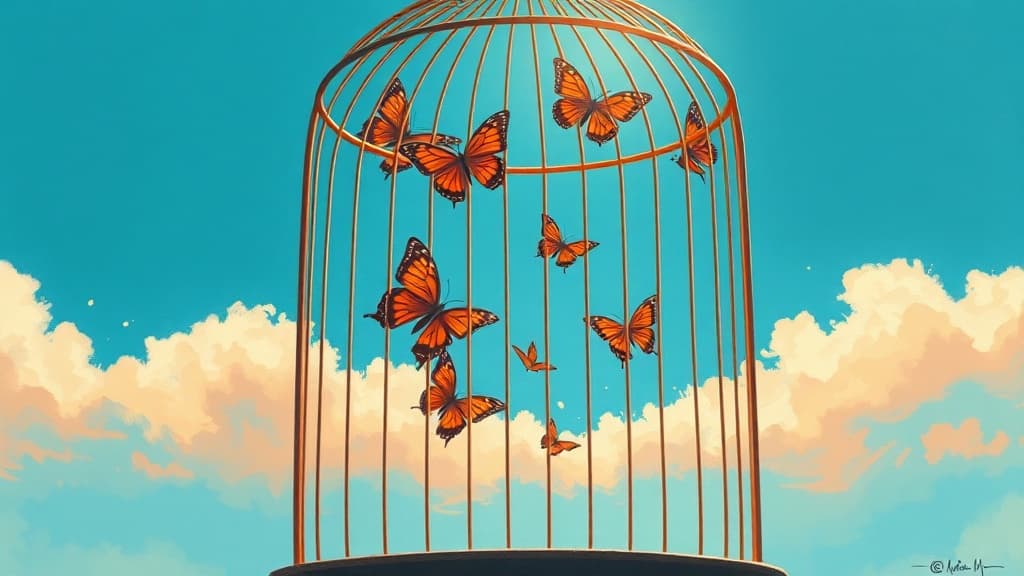
7 Powerful Keys to Break Free from Repetitive Family Patterns
Have you ever caught yourself behaving exactly like your parents? Repeating the same conflicts, the same fears, the same limitations? It's completely normal, and that's exactly what we're going to discuss today.
Repetitive family patterns are like invisible programs running in the background of our consciousness. They shape our reactions, our choices, our relationships, often without us even realizing it. These family energetic fields - these collective energies passed down from generation to generation - can keep us trapped in patterns that don't even belong to us.
The good news? You can break free from them. Right now. Not "someday," not "after years of therapy," but today.
Understanding how to break free from repetitive family patterns means reclaiming power over your life. It's about consciously choosing who you want to be, rather than being controlled by who you were programmed to become.
So, do something pointless and beautiful: free yourself from what isn't truly you. That's often where happiness hides.
1. Identify the Invisible Patterns
Awareness is the first act of freedom.
Most of us reproduce family patterns without even seeing them. These patterns are like water to a fish: so present they become invisible.
To identify your repetitive family patterns, start by observing your automatic reactions. When do you feel anger? Fear? In what situations do you repeat the same phrases as your parents? What are your recurring emotional triggers?
Take Marie, 35, who would explode with anger every time her children left their things lying around. Digging deeper, she realized she was reproducing exactly the same rage outbursts as her mother, who couldn't stand "mess." It wasn't even HER anger, but one inherited from her maternal lineage.
Practical exercise: For one week, note in a journal every time you catch yourself reacting "like dad" or "like mom." Without judgment, just observation. This simple awareness already begins to weaken the pattern's grip.
Identifying patterns is like turning on the light in a dark room. Suddenly, you see what was always there.
2. Understand the Origin Without Playing Victim
Understanding liberates, victimization chains.
Once your patterns are identified, the next step is understanding their origin without falling into the victimization trap. Your parents did their best with the tools they had. They themselves inherited patterns they may never have questioned.
This understanding isn't an excuse, it's a liberation. When you understand that your fear of abandonment comes from your mother's complicated relationship with her own father, you realize this fear isn't "you." It's an emotional inheritance you can choose to transform.
Thomas discovered that his difficulty expressing emotions came from three generations of men in his family who learned that "men don't cry." His grandfather, traumatized by war, had passed this belief to his father, who passed it to Thomas. Understanding this chain allowed him to break the cycle with his own sons.
Practical exercise: For each identified pattern, trace its genealogy. Where does it come from? In what historical or family context was it born? This research helps you see the pattern as an external system you can modify.
Understanding without victimizing yourself means reclaiming your creative power.
3. Create New Family Rituals
New rituals create new energies.
Repetitive family patterns are reinforced through repetition of unconscious habits and rituals. To transform them, consciously create new rituals that embody the values you want to transmit.
If your family of origin communicated through conflicts and reproaches, establish a daily gratitude ritual. If emotion was banished, create a listening moment where everyone can express what they feel without judgment.
Léa transformed the tense family dinners of her childhood into moments of authentic connection. Every evening, she asks her family: "What was your most beautiful discovery today?" This simple ritual changed the energy of the entire family and created a new pattern of curiosity and sharing.
Rituals have enormous power because they create new positive energetic fields. They physically and emotionally anchor the new energies you want to cultivate.
Practical exercise: Choose an old negative family ritual and replace it with a new positive ritual. For example, replace Sunday afternoon reproaches with a moment celebrating the week's successes.
Every new ritual is a seed of liberation that grows with time.
4. Practice Emotional Differentiation
Your emotions belong to you, others' emotions belong to them.
One of the most powerful aspects of learning how to break free from repetitive family patterns is learning to differentiate your emotions from those of your family. Many of us carry the fears, anger, and sadness of our loved ones as if they were our own.
This emotional fusion keeps patterns alive. When you feel your mother's anxiety about the future, you feed her fear pattern. When you carry your father's anger against the world, you perpetuate his frustration pattern.
Emotional differentiation means learning to say: "This emotion I'm feeling, is it really mine or am I carrying something that belongs to someone else?"
Julien realized he was living with constant anxiety that wasn't his, but his grandmother's who had lived through war. By learning to "return" this anxiety with love and gratitude, he found his natural serenity again.
Practical exercise: When you feel a strong emotion, ask yourself: "Who does this emotion really belong to? Am I feeling it or am I carrying something for someone else?" Then visualize yourself returning this emotion to its rightful owner with love.
Emotional differentiation means finding your authentic identity.
5. Transform Inherited Limiting Beliefs
Beliefs are choices, not truths.
Every family transmits an invisible but powerful belief system. "Money doesn't grow on trees," "You have to suffer to succeed," "People like us don't succeed," "Love hurts"... These phrases, heard a thousand times, become limiting programs.
To break free from repetitive family patterns, it's essential to identify these inherited beliefs and question them. Are they really true? Do they serve you? Do they correspond to who you want to be?
Sophie grew up with the family belief that "women must sacrifice themselves for their family." This belief led her to complete exhaustion. By questioning it, she realized she could be a loving mother AND take care of herself. She transformed this belief into: "Taking care of myself allows me to better care for others."
The belief transformation process requires patience and repetition. Your mind will resist, that's normal. It prefers the known, even if limiting, to the liberating unknown.
Practical exercise: List 10 beliefs you inherited from your family. For each, ask yourself: "Do I still believe this? Does it serve me?" Then reformulate each limiting belief into a liberating belief.
Transforming your beliefs means rewriting the code of your reality.
6. Develop Your Unique Identity
You are not your parents, you are you.
One of the major challenges in learning how to break free from repetitive family patterns is developing an identity that is truly your own. Many of us define who we are in relation to our family: "I'm like dad," "I'm not like mom," "I'm the black sheep"...
Developing your unique identity means discovering who you are independently of your family history. What are YOUR values? YOUR dreams? YOUR natural ways of being in the world?
This exploration can be scary because it asks you to leave the familiar family cocoon. But that's where your true freedom and authentic happiness lie.
Mark always defined himself as "the family rebel," defining himself in opposition to his traditional parents. By developing his own identity, he discovered he was neither traditionalist nor rebel, but simply creative and independent. This discovery freed him from the need to oppose and allowed him to create more harmonious relationships with his family.
Practical exercise: Spend an entire day noting what makes you vibrate, inspires you, gives you energy - without reference to your family. Create a list of "who I really am" based solely on your personal observations.
Your unique identity is your most beautiful gift to the world.
7. Practice Liberating Forgiveness
Forgiveness frees you, it doesn't free others.
Forgiveness is often misunderstood. It's not about excusing hurtful behaviors or resuming toxic relationships. Liberating forgiveness means releasing the emotional charge that keeps you connected to old patterns.
As long as you carry anger, resentment, or grudges toward your family, you remain energetically linked to the patterns you want to transform. Forgiveness cuts these invisible ties.
Also forgive yourself for having reproduced certain patterns. You did your best with the consciousness you had at that moment. Today, you have more consciousness, therefore more choices.
Anne spent years resenting her mother for her lack of affection. This resentment prevented her from receiving love in her own life. By forgiving (without excusing), she freed the space within herself to welcome the love she deserved.
Liberating forgiveness isn't a one-time event, it's a process. Sometimes, you'll need to forgive the same thing several times until your heart is truly free.
Practical exercise: Write a forgiveness letter (that you won't send) to each family member who hurt you. Express everything, then end with: "I forgive you and I free myself." Then burn the letter.
Forgiveness is the key that opens the prison you built for yourself.
Bonus: Create Your New Lineage
You are the ancestor of your new lineage.
Here's the surprise point that will transform your perspective: you're not just freeing yourself from past family patterns, you're creating the new lineage of your future family.
Every pattern you transform, every belief you liberate, every new behavior you adopt becomes a gift for future generations. Your children, grandchildren, and the generations that follow will inherit your liberation work.
This vision changes everything. You're no longer a victim of the past, you're a creator of the future. You become the conscious ancestor of your new lineage.
Imagine in 100 years, your descendants thanking you for having broken the invisible chains and created new patterns of freedom, love, and authenticity.
Practical exercise: Write a letter to your descendants 100 years from now. Explain to them the patterns you transformed and the new energies you're transmitting to them. This letter becomes your sacred commitment to the future.
You are the conscious link that transforms the entire chain.
Conclusion: Your Freedom Starts Now
Learning how to break free from repetitive family patterns isn't a life project, it's a decision of the present moment. Every moment you consciously choose a different response, you break a little more of the invisible chains of the past.
The seven keys we've explored - identifying patterns, understanding without victimizing, creating new rituals, practicing emotional differentiation, transforming beliefs, developing your unique identity, and practicing liberating forgiveness - are powerful tools you can use right now.
Your happiness doesn't depend on your family history. It only depends on your ability to choose, now, who you want to be.
Your challenge for the next 7 days: Choose one of the seven keys and apply it consciously every day. Observe how this simple practice begins to transform your energy and relationships.
You deserve to be free. You deserve to be you.
Happiness is now ◯
If this article resonates with you and you want to go further in your personal liberation, discover the Humans.team community. We are a movement of awakened consciousnesses