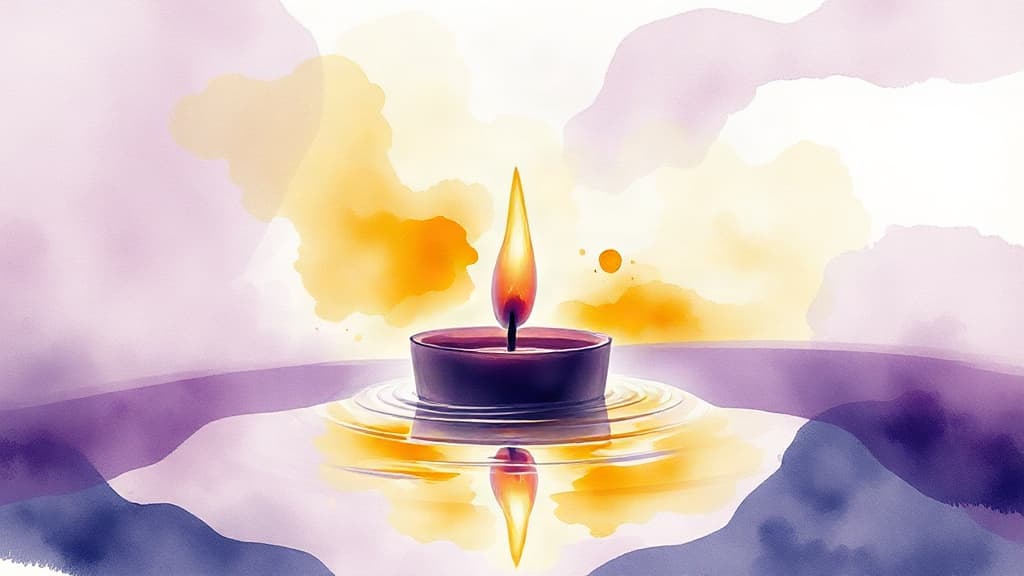
How to Create a Mental Space of Freedom When Life Seems to Dictate Its Terms
You wake up in the morning, and before you've even opened your eyes, the list begins. Meetings, obligations, other people's expectations, debts, fears. The day hasn't started yet and you already feel the weight of it all.
And yet — right here, in this exact moment — you're breathing.
Without thinking about it, without effort, without anyone's permission. Air comes in, air goes out. A miracle you've forgotten to notice. What if it was right here, in that forgetting, that the key to everything was hiding?
The real question isn't: "How can my life be freer?" It's: "How to create a mental space of freedom when life seems to dictate its terms?"
Because the constraints don't disappear. The bills remain. The complicated relationships remain. The lack of time remains. But something can change — radically — in the way you inhabit all of it.
This article is for you, if you sometimes feel like life is calling all the shots. It contains no miracle promises. It contains something more valuable: concrete keys to reclaiming space where you thought there was none left.
What a "Mental Space of Freedom" Really Is — and What It Isn't
We often confuse mental freedom with the absence of problems. They're not the same thing.
A mental space of freedom isn't a state where everything is fine, where you have no more worries, where your to-do list is empty. That would be an illusion — and an expectation that would keep you imprisoned indefinitely.
A mental space of freedom is an inner zone that no one can invade without your permission. It's the place inside you where you observe your life instead of being swept away by it. Where you choose your response instead of being at the mercy of your reactions.
The Stoics understood this two thousand years ago. Marcus Aurelius ran an empire, waged wars, managed perpetual crises. And every morning, he wrote in his personal journal to keep that space intact. Not to escape his reality. To move through it with clarity.
Mental freedom isn't a destination. It's a practice. A way of being in the world that is cultivated, day after day, even — and especially — when life seems to dictate its terms.
Why This Inner Space Concretely Changes Your Life
You might be thinking: "That's all well and good, but it doesn't pay my bills." True. And yet.
When you don't have this mental space, you make decisions from a place of panic. You react from fear. You accept situations that don't feel like you because you've lost access to what you actually want. You get swept up in collective currents of urgency, comparison, and performance pressure — without even realizing it.
When you do have this space, something fundamental shifts. You start responding instead of reacting. You regain access to your creativity, your intuition, your ability to solve problems differently. The same constraints exist, but you no longer carry them the same way.
Neuroscience research confirms what wise traditions have always taught: a brain in chronic stress literally loses processing capacity. It narrows its options. Mental space, in an almost neurological sense, disappears.
Conversely, a brain that has access to moments of calm and presence regains plasticity, creativity, and the ability to see what was previously invisible. If you want to go deeper on this path, you'll find valuable practices in this article on how to calm your mind in 5 minutes.
Mental freedom isn't a spiritual luxury. It's a concrete necessity for living well.
The Keys to Creating This Mental Space, Even When Everything Feels Closed Off
Here are the practices that actually work. Not in theory — in real life, with real constraints.
1. Start by Recognizing What You Actually Control
The first key is radical honesty with yourself.
Take a sheet of paper. Draw a line down the middle. On one side, what you control (your thoughts, your responses, your choices, your actions). On the other, what you don't control (other people, the past, the economy, the weather).
Now notice: where do you spend 80% of your mental energy?
Most of us exhaust our inner space on the right-hand column. We go around in circles about what we can't change. And meanwhile, the left-hand column — where our real power lies — remains untapped.
Bringing your attention back to what you can actually influence is the first act of liberation.
2. Create Conscious Transition Thresholds
Modern life is a series of contexts that follow one another without a breath. You move from work to family, from family to social media, from social media to sleep — without ever truly shifting your inner mode.
A transition threshold is a short ritual — 30 seconds to 5 minutes — that marks the passage from one space to another.
It might be three deep breaths before walking in the door after work. A minute of silence in your car before starting the engine. A glass of water drunk slowly, mindfully, between two meetings.
These micro-pauses aren't wasted time. They are doorways into your inner space. And over time, they accumulate to create a qualitatively different life.
3. Make Peace with Silence Instead of Running from It
Many people are afraid of silence. The moment it arrives, they reach for their phone, put on music, start a video. As if the quiet were dangerous.
But silence isn't emptiness. Silence is the space where you can finally hear yourself.
Knowing how to build a peaceful relationship with silence is one of the most transformative skills you can develop. You don't need to meditate for an hour. Start with two minutes of intentional silence per day. Just being there, without any external input.
Silence is the antechamber of mental freedom.
4. Distinguish Real Urgency from Imposed Urgency
A large part of our mental constraints come from urgencies that aren't really ours.
The urgency to reply to messages immediately. The urgency to please, to be available, to perform. The urgency to have an opinion on everything happening in the world. These urgencies are real — in the sense that they create real pressure. But they are rarely truly urgent.
Ask yourself honestly: "If I don't do this in the next hour, what actually happens?"
Often, the answer is: nothing. Or almost nothing. And that realization frees up a considerable amount of mental space.
5. Anchor Freedom in the Body, Not Just the Mind
We tend to think that mental space is created in the head. That's a mistake.
The body is the primary space. When your body is tense, so is your mind. When you breathe deeply, when you move, when you feel the ground under your feet — you send your nervous system a signal of safety. And it's from that signal of safety that mental space opens up.
Remember the air you're breathing. That miracle you forgot to notice. It's here, right now, available to you. Three slow, deep breaths literally change your inner chemistry within seconds.
The body is always in the present. That's where freedom lives.
Practical Application: Your First Space of Freedom, Today
Here's a simple protocol you can start in the next few hours. Not tomorrow. Today.
Morning (3 minutes): Before looking at your phone, stay lying down or sitting for one minute. Breathe. Ask yourself one single question: "How do I want to feel today?" Not what you need to do — how you want to be. Write down a word, a sentence.
During the day (30 seconds, 3 times): Set a discreet alarm at three points during the day. When it goes off, stop. Three breaths. One question: "Am I reacting or choosing right now?"
Evening (5 minutes): Before falling asleep, note one thing you controlled today. Not a spectacular achievement — just a moment where you chose your response rather than being at the mercy of your reaction. Celebrate that.
This protocol seems simple. It is. And that's exactly why it works.
If you're looking to go further and maintain this space even when your schedule is overflowing, explore how to nourish your inner life when you don't have time. And if you want to understand how to transform your professional day-to-day, you'll find concrete ideas on how to create a workspace that sparks creativity.
Freedom doesn't begin when the constraints disappear. It begins now, with what you have.
One Last Word Before You Close This Article
Life will keep on having its constraints. That's certain.
Seasons change. Challenges return. Other people don't always change. Money doesn't grow on trees. Loss comes.
But you — you can change the way you inhabit all of it.
Knowing how to create a mental space of freedom when life seems to dictate its terms isn't a skill reserved for monks or philosophers. It's something you can start cultivating today, with three breaths, with thirty seconds of silence, with one honest question in the morning.
The air you breathe is a miracle. Your capacity to choose how you look at life is another.
And that miracle — no one can take it from you.
Happiness is now ◯
What constraint in your life is weighing most heavily on your mental space right now? What if you started by simply naming it — without solving it — just to see what that releases?
At Humans.team, we explore these paths toward a freer, more conscious life together. If these questions resonate with you, join the movement — not to get ready-made answers, but to move forward surrounded by people who are searching, just like you, for a life truly lived.