How to Organize Your Week When You're Tired: The Art of Doing Less, Better, and More Gently
It's Sunday evening. You look at the week ahead in your calendar, and something tightens in your chest. The appointments, the deadlines, the family obligations, the messages waiting for a reply… And you're already tired before you've even started.
Maybe you tell yourself: "I should be more organized." Or worse: "Why can everyone else manage this and I can't?"
Breathe. Nothing in you is broken. Fatigue isn't a character flaw, it's information. And when you learn to listen to it rather than fight it, you discover there's a way to move through your weeks gently, even when your tank is running low.
In this article, we'll explore together how to organize your week when you're tired, without guilt, without unrealistic promises, using simple gestures you can start applying today.
As today's thought puts it: "The rain nourishes what grows within you too. Be patient." This season of tiredness may not be an obstacle. It may be the rain.
Understanding What's Really Happening When You're Tired
Before we talk about organization, we need to understand what fatigue actually is. Because most productivity advice starts from a false premise: that of constant energy, available on demand.
Fatigue Changes How We Function
When you're tired, your brain doesn't work the way it usually does. Your ability to concentrate drops. Your decisions become slower and more painful. Your tolerance for frustration shrinks. Everything takes more effort, even the simple things.
That's normal. Your body and mind are telling you something, and that message deserves to be heard.
The Trap of "Before" Organization
The first instinct when you're exhausted is to try to take back control with an ambitious schedule. You fill in every slot, promise yourself you'll "catch up," and plan days fit for someone at the peak of their energy.
The result: the plan collapses by Tuesday, guilt sets in, and the fatigue gets worse.
Knowing how to organize your week when you're tired calls for a different approach. It's not about doing just as much with less energy. It's about redefining what truly matters and building a week that fits the energy you actually have.
Fatigue Is Not Your Enemy
Here's a powerful shift in perspective: what if your fatigue were a compass? It points to the places where something needs slowing down, lightening, rethinking. It shows you where you're scattering yourself, where you say yes out of habit, where you're carrying things that don't belong to you.
It's not a punishment. It's an invitation to realign.
Why This Matters in Your Life
You might think: "I'm holding on, I'll deal with it later." But waiting until you feel better to organize differently often means waiting indefinitely.
A Poorly Calibrated Week Deepens the Fatigue
When you ignore your tiredness and keep up an unsustainable pace, you enter a loop: you sleep badly, you recover badly, you accomplish less, you feel guilty, you pressure yourself, you sleep even worse.
Simply adjusting your week to your real energy level can break that loop. Not overnight, but gradually, day by day.
Your Quality of Life Is Made in the Ordinary
Happiness doesn't hide in big events. It happens in how you get through an ordinary Tuesday afternoon, in the way you speak to yourself when you haven't finished everything, in the space you give yourself to breathe.
Learning how to organize your week when you're tired means learning to treat yourself with the same kindness you'd offer an exhausted friend. It's an act of self-respect.
You Protect What Truly Matters
When energy is limited, it becomes precious. And that scarcity can become a gift: it forces you to choose. To tell the essential from the incidental. To stop squandering your strength on what doesn't nourish you.
Many people say their period of fatigue was when they finally dared to simplify their lives. If you often feel scattered by the sheer number of your commitments, this article on managing your energy when you have too many projects may offer a helpful perspective.
Practical Keys to Organizing Your Week When You're Tired
Let's get practical. Here are five simple keys that require no special equipment and no superhuman energy.
1. Start With Your Energy, Not Your To-Do List
Most schedules start from the tasks to be done. Flip the logic: start from your energy.
Take five minutes, on Sunday or Monday morning, and ask yourself:
- When during the day do I feel least depleted?
- Which days are naturally heavier for me?
- What recharges me, even a little?
Then place your important tasks in your best time slots, and leave the low-energy moments for lighter things or for rest. This one adjustment changes everything.
2. Use the Rule of Three Essentials
When you're tired, a list of twenty tasks is a source of anxiety. Replace it with a simple rule: each day, choose three essential things. Not ten. Three.
Ask yourself: "If these are the only three things I do today, will my day have meaning?" If the answer is yes, you have your day. Everything else is a bonus, never an obligation.
This approach echoes what we explore in the article on how to manage your priorities when everything feels urgent: finding calm in the heart of chaos starts with deciding what truly matters.
3. Build "Buffer Zones" Into Your Calendar
A schedule with no room to breathe is a fragile schedule. When you're tired, everything takes longer than planned: the commute, the meeting that runs over, the task that demands more concentration.
So build in buffer zones: 15 to 30 empty minutes between commitments, a free half-day in the middle of the week, an evening with nothing planned. These spaces aren't wasted time. They're the shock absorbers that keep your week from falling apart at the first unexpected thing.
4. Learn to Say "Not This Week"
Saying no is hard. But saying "not this week" is often easier, and just as liberating.
When a request comes in, you don't have to turn it down for good. You can simply say: "I'm running low on energy right now, can we push this back by a couple of weeks?" Most people understand far better than you'd expect. And those who don't teach you something useful about the quality of the relationship.
Ask yourself this before agreeing to anything: "Do I really want this, or am I doing it out of fear of letting someone down?" That fear is often fueled by collective expectations we've absorbed without ever choosing them. What we call egregores: those invisible pressures of "you must always be productive." We can recognize them, and decide to stop obeying them.
5. Make Rest a Ritual, a Priority and Not a Reward
We tend to treat rest as something we allow ourselves once everything is done. But when you're tired, everything is never done, and rest never comes.
Change the rule: put your rest in your calendar as a non-negotiable appointment. A twenty-minute walk. A nap. An hour without screens. A coffee in silence. This time isn't a luxury. It's what allows everything else to hold together.
Many people find that mornings are their best resource. If that's you, you'll probably enjoy this reflection on the art of early mornings for rediscovering your focus.
Immediate Practical Application: Your Gentle Week in 15 Minutes
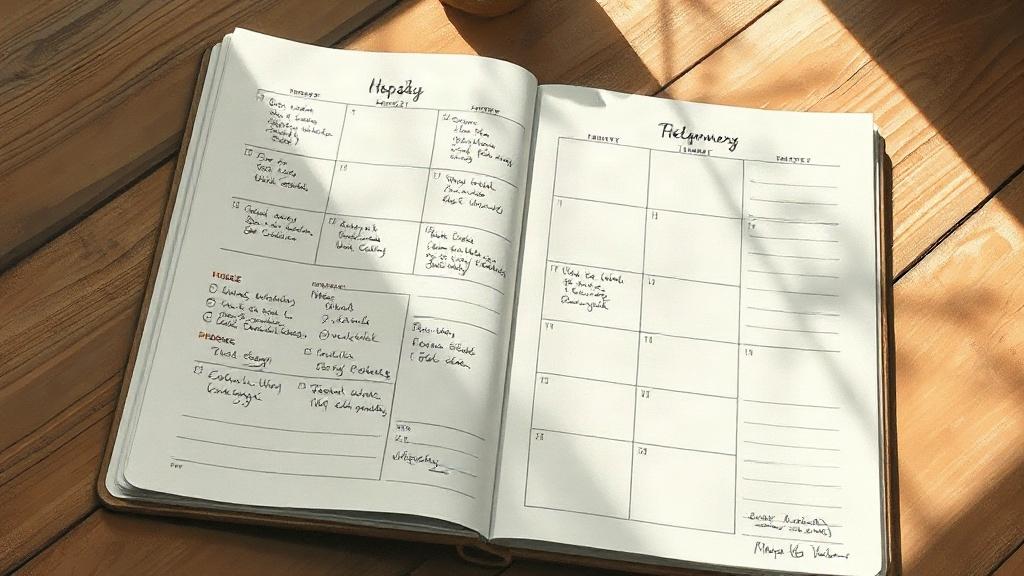
Enough theory. Here's a concrete exercise to do right now, or to come back to on Sunday evening. All you need is a sheet of paper, a pen, and fifteen minutes.
Step 1: Take Inventory (5 minutes)
Write down everything that's waiting for you this week: appointments, tasks, obligations, wishes. Empty your head onto the page, without sorting.
Step 2: Sort With Three Questions (5 minutes)
For each item, ask yourself:
- Is this truly necessary this week? If not, postpone it or drop it.
- Can someone else take care of it? If so, delegate or ask for help.
- Can I simplify it? A "good enough" version is often more than enough.
The goal isn't perfection. It's to keep only what truly deserves your energy.
Step 3: Place Your Three Essentials for Each Day (3 minutes)
For each day of the week, write down three priorities at most. No more. Then add an explicit moment of rest, even a short one: "5 p.m.: walk," "9 p.m.: reading," "Saturday morning: nothing."
Step 4: Prepare Your Plan B (2 minutes)
Write in a single sentence what you'll do if the fatigue gets worse: "If I'm running on empty, I only do essential number one, and I give myself permission to stop."
Having a plan B takes an enormous amount of pressure off. You know in advance that you're allowed to slow down, and that permission is one you've given yourself.
A Word About the Evening
End each day with a gesture of gratitude. No need for an elaborate ritual: a single sentence is enough. "Today, I did what I could, and it was enough."
Gratitude is a way of telling your brain: "Look at what's here, not just what's missing." And it's surprisingly powerful for recharging your energy.
Conclusion: The Season of Patience
If you're tired right now, remember: fatigue is not an ending. It's a season.
Like rain that seems to slow down life above ground, but quietly nourishes what's growing beneath the soil, this period of slowing down is preparing something in you. A new clarity. A truer way of living. A gentler relationship with your energy.
You don't have to wait until you're "finally rested" to be happy. Happiness is decided now, in the way you choose to move through this week: with gentleness rather than harshness, with presence rather than pressure.
So here's a question for you:
What's the one thing you can lighten in your week today, to give yourself a little breathing room?
Take the time to answer honestly. That small gesture could be the beginning of a big change.
If this article resonated with you, you're invited to explore humans.team, a space for those who want to live more consciously, free themselves from invisible pressures, and rediscover the taste for what's essential. No miracle promises, just a community moving forward, step by step, toward a more aligned life.
Happiness is now ◯