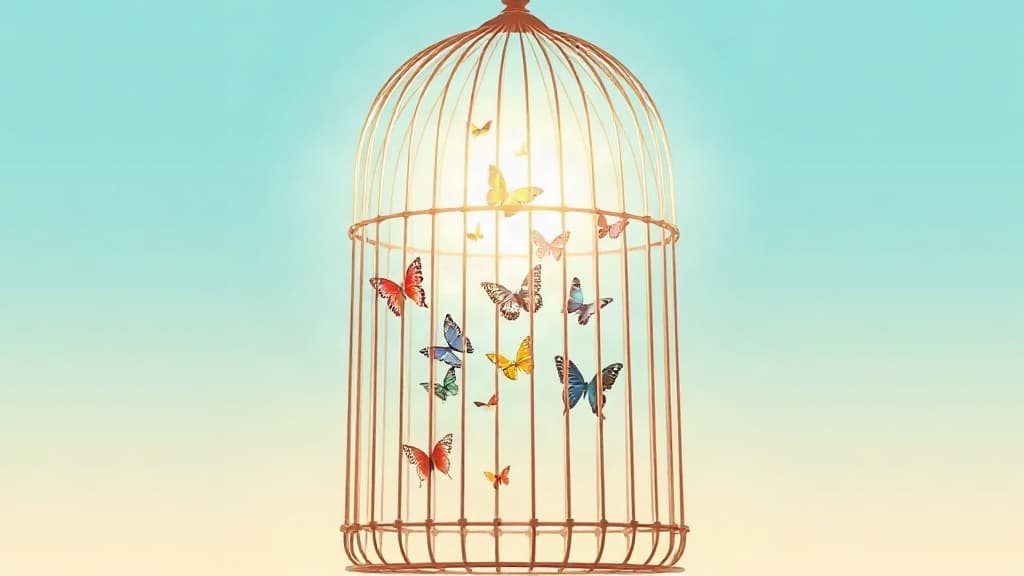
How to Break Free from Social Media Addiction and Reclaim Your Presence
You put your phone down. Two minutes pass. You pick it up again.
You don't even know why. There's nothing new. Nothing urgent. Nothing that actually deserves your attention. And yet, your hand grabbed it on its own — a reflex you no longer really control.
If you recognize yourself in this scene, you're not alone. Billions of people live this same daily little theater, this unconscious dance between themselves and their screen. And somewhere, deep down, you sense that something's off. That this habit is costing you something important.
Time. Energy. Your presence in your own life.
That's what this article is here for: to understand what's really going on, and above all, to explore how to break free from social media addiction — not with guilt, but with awareness and self-compassion.
Understanding What's Actually Happening in Your Brain
This isn't a willpower problem
The first thing to understand — and this is crucial — is that if you're spending too much time on social media, it's not because you're weak or undisciplined.
Platforms like Instagram, TikTok, Facebook, and X were designed by teams of neuroscientists and behavioral psychologists. Their mission: maximize the time you spend on the app. Every notification, every like, every endless scroll is a carefully engineered mechanism to trigger a small hit of dopamine in your brain.
It's the same mechanism as slot machines in a casino. You never know what you're going to find when you scroll through your feed. That uncertainty is precisely what creates the hook.
The digital egregore: a collective energy that pulls you in
In the Humans.team philosophy, we talk about egregores — those invisible collective energies that influence us without our awareness. Social media has created one of the most powerful egregores in human history.
Millions of people scrolling at the same time, all seeking validation, distraction, connection. This collective energy creates a kind of gravitational field. And when you open your app, you enter that field. You let yourself get pulled in.
Understanding this changes everything. You're not broken. This is an external force — one you can learn to recognize, and therefore consciously choose.
Why Breaking Free from Social Media Addiction Genuinely Changes Your Life
What you're losing without realizing it
A recent study estimates that the average user spends between 2.5 and 4 hours per day on social media. Over the course of a year, that's between 900 and 1,460 hours. That's between 37 and 60 full days. Of your life.
But it's not just time. It's quality of attention. Every digital interruption cuts your train of thought. After each notification, it takes an average of 23 minutes to return to a state of deep focus. Do the math on what that means for your day.
And then there's this less visible but equally real effect: the constant comparison. You see curated lives, perfect bodies, staged successes. And without realizing it, you measure your real life against these digital fictions. It's exhausting. And often, it's a deep source of unhappiness.
Many people who explore how to break free from the need to please everyone discover that social media amplifies exactly that need — and that by pulling back from it, something more authentic can finally emerge.
What you reclaim when you take back control
When you start to break free from social media addiction, something unexpected happens: you rediscover inner space.
Room to think. To dream. To feel. To simply be there, in your own life, instead of watching it unfold through someone else's screen.
The present becomes livable again. And that's where everything begins.
Practical Keys to Breaking Free from Social Media Addiction
1. Start by observing without judging
Before changing anything, observe.
Install a screen time tracking app (most smartphones have one built in). See how many times you open each app per day. Identify your trigger moments: waking up, meals, boredom, loneliness, anxiety.
This observation isn't about beating yourself up. It's about understanding. Because you can't change what you can't see.
2. Create screen-free spaces — intentionally
Freedom doesn't come from prohibition. It comes from intention.
Rather than telling yourself "I need to stop looking at my phone," create sacred zones in your day. The first hour of the morning, screen-free. Meals, fully present. The last hour before bed, disconnected.
These spaces become recovery islands for your brain. And gradually, you rediscover something priceless: the pleasure of simply being here.
3. Replace rather than eliminate
The void left by a habit always calls for something to fill it.
If you cut out scrolling without putting anything in its place, you'll go back. So plan ahead. What would you do with that reclaimed time? Read? Walk? Cook? Call someone you genuinely care about?
Prepare your list. And when the urge to scroll hits, deliberately choose one of those alternatives. Not by force. By desire for something better.
4. Turn off notifications (almost all of them)
Notifications are the hooks. Every little ping is an invitation to step out of your life and into theirs.
Turn off all non-essential notifications. Maybe keep direct phone calls. Everything else can wait. You check social media when you decide to — not when it demands your attention.
This one simple move restores an enormous sense of power. You're no longer reacting. You're choosing.
5. Question the underlying need
Social media addiction is rarely the real problem. It's usually a symptom.
A symptom of chronic boredom. Of loneliness. Of an unmet need for validation. Of anxiety you're trying to drown in the information stream. Of energetic blocks looking for an easy outlet.
Ask yourself honestly: when I open my phone, what am I hoping to find? Connection? Approval? A distraction from something uncomfortable?
Exploring these deeper energetic blocks can profoundly transform your relationship not just with screens, but with yourself.
Immediate Practical Action: Your Plan for This Week
Here's what you can do starting today — not "someday," not "when I'm ready" — right now.
Day 1 — Audit your reality. Tonight, look at your screen time from the past week. Write down the numbers. Receive them without judgment. Just with curiosity.
Day 2 — Create a sacred zone. Choose ONE moment in your day to leave your phone in another room. Just one moment. An hour is enough to start.
Day 3 — Turn off notifications. Spend ten minutes going into your settings and turning off all notifications from social media apps. You check them when you want to. Not when they demand it.
Day 4 — Prepare your alternatives. List 5 activities that genuinely nourish you. Things that belong to you, away from screens. Put that list on a sticky note near your phone.
Day 5 — Observe your triggers. Today, every time you feel the urge to open an app, pause first and ask yourself: What am I feeling right now, just before I open the app? Just observe. No forcing.
Day 6 — Try a half-day disconnected. Choose a morning or an afternoon. Let the important people in your life know you're reachable by phone if needed. And taste what it feels like to move through a few hours without the feed.
Day 7 — Celebrate and adjust. Look at what worked. What was hard. Not to judge yourself, but to build a strategy that truly fits you.
Breaking free from social media addiction isn't about perfection. It's about direction. And this journey connects to other important liberations — like breaking free from toxic perfectionism — all of which point toward the same thing: coming back to yourself.
What This Freedom Reveals About You
There's something deeply beautiful in this process.
By choosing to break free from social media addiction, you're not just reclaiming time. You're affirming something essential: your life deserves your attention.
Not the attention you give to other people's lives. Not the fragmented attention that algorithms compete over. Your real attention — whole, present, alive.
And often, when you start reconnecting with yourself this way, other things open up too. Relationships that deepen because you're actually there. Creativity that reawakens because you've given it space. A more stable sense of self that no longer needs to verify itself through the digital gaze of others.
Some people even find that their relationships shift — that they let go of control, that they're more relaxed, more present with the people they love. That's no coincidence. Letting go in relationships and letting go of social media share the same root: trusting real life.
Conclusion: Your Life Is Happening Right Now
"The present moment is the only place where life actually happens."
Every time you scroll on autopilot, you leave the present. You absent yourself from your own existence to virtually inhabit someone else's. And your life — your actual life — keeps unfolding without you.
Knowing how to break free from social media addiction is ultimately about learning to choose the present. Again and again. Not perfectly. But consciously.
This isn't a path of deprivation. It's a path of return. Back to your thoughts, your sensations, your relationships, your creativity. Back to what is real.
And that starts now. Not tomorrow. Not when you have more motivation. Now.
A question for you: When you imagine a day without social media, what do you feel? Relief? Anxiety? Both? Take a moment to sit with that honestly.
If this article resonated with you and you want to explore this path of conscious liberation further, the Humans.team movement is a space for exactly that. No miracle recipes, no empty promises — just a community of humans who choose, every day, to return to what matters.
Come take a look at humans.team when you feel ready. ◯
Happiness is now ◯