How to Keep Your Resolutions After November: A Guide to Making Them Last
You probably remember it. A few weeks ago, you had that clear, almost electric energy. You were going to do it, finally. The exercise, the writing, that project that's been circling in your head for months, that gentler way of moving through your days.
And then November arrived, with its low sky, its evenings that fall dark at 5 p.m., its dull tiredness. Little by little, quietly, the momentum faded. Not all at once, not in any dramatic way. Just one day missed, then two, then a habit slipping away.
If you recognize yourself in this, one thing first: you haven't failed. You're one of the billions of humans who discover, every year, that how to keep your resolutions after November is a real question, not a simple matter of willpower.
In this article, we'll look at what's really going on, and above all at what you can do starting today. No guilt-tripping, no miracle promises. Just clarity, gentleness, and keys that actually work.
Understanding Why Resolutions Crumble in the Fall
Let's start by dismantling a myth: the idea that you simply lack willpower.
Most resolutions are born in a moment of momentum. A new year, a fresh start, an emotional spark. In that state, everything seems possible. The problem is that momentum is an emotion, and emotions fluctuate. Building your life on an energy peak is like building a house on a wave.
November is a particularly cruel test. The light fades, the body slows down, and the social pace speeds up as the end of the year approaches. The initial excitement has worn off, and concrete results aren't visible yet. This is the hollow zone, the one where many people give up.
There's also what we call egregores at Humans.team: collective energies that move through us without our noticing. The egregore of performance whispers that everything must be done perfectly. The egregore of comparison shows us others who seem to be "keeping up" better. The egregore of autumn fatigue invites us to let everything go until spring.
You're not weak. You're simply being carried along by currents that aren't your own.
Understanding this changes everything. If your momentum dips, it's not a character flaw. It's a natural cycle that no one ever taught you how to work with. And this phenomenon has a quiet cousin: that strange moment when everything stops after an intense period. If that resonates with you, you'll find some ideas in this article on the emptiness that follows intensity.
Why This Matters in Your Life
You might think keeping your resolutions is just a matter of personal performance. Ticking boxes, becoming "better." That's not what we're talking about here at all.
Your resolutions are messages from you to yourself. When you decide to move more, to write, to sleep better, or to spend time with the people you love, you're expressing a deep need. Something in you is asking for space, vitality, meaning.
Every time you abandon those intentions while judging yourself, you send another message to your brain: "I can't be relied on, even by myself." And that message, repeated, erodes your self-confidence far more than any single failure.
Conversely, every small step you follow through on, however tiny, feeds a precious conviction: "I can count on myself." That's the real treasure of resolutions. Not the end result, but the relationship you rebuild with yourself.
And the good news is that this relationship can be repaired at any moment. No need to wait for January 1st, a Monday, or the next "right time." Happiness is now, and so is starting over.
Keep in mind this phrase that guides us today: "Every beat of your heart is a small yes to life." Your resolutions are nothing more than that: small, repeated yeses, not a contract for perfection.
Practical Keys to Making It Last
Here are five simple, tried-and-tested levers you can apply this week. Take the ones that resonate with you; there's no need to use them all.
Shrink Your Resolution Until It's Almost Laughable
The classic mistake: aiming too big. "Run five times a week," "meditate 30 minutes every morning," "write for two hours a day." These goals look beautiful on paper and are unsustainable in a busy week of November.
Do the opposite. Shrink it until it feels almost too easy. Five minutes of walking. Two sentences written. Three conscious breaths.
Why does it work? Because the brain resists effort, not habit. Once the gesture is in place, it becomes natural to extend it. A small daily step always beats a big weekly one.
Anchor Your Action to a Moment That Already Exists
Habits that last don't rely on memory or motivation. They rely on anchors.
Choose a fixed moment in your day: your morning coffee, brushing your teeth, coming home, your lunch break. Then attach your new action right after it. "After my coffee, I write three lines." "When I get home, I do five stretches."
You no longer have to decide, remember, or negotiate with yourself. The action settles into the groove of a ritual that already exists.
Welcome the Energy Dips Instead of Fighting Them
This is probably the most important key, and the most forgotten. Your energy isn't linear. It rises, it falls, it rests. Fighting these cycles just wears you out for nothing.
If you understand why momentum erodes, you can anticipate it and move through it rather than being at its mercy. This article on why you lose motivation after a few weeks explores exactly this mechanism and how to find your natural drive again.
In practice, plan your "minimum version" right now: the smallest action you can take on low-energy days. On those days, you're not doing nothing. You're doing the minimum, and that minimum preserves continuity.
Replace Guilt with Curiosity
Skipped three days? Slipped back into your old pattern? There are two possible reactions: judge yourself, or ask what happened.
Guilt drains the energy you need to start again. Curiosity, on the other hand, turns every lapse into valuable information. What made me drop off? Which part of the day was too hard? What did I really need?
A lapse isn't a failure, it's feedback. And if the idea of failure still weighs on you, take a look at how to turn failure into a springboard toward renewed motivation. You'll see that the best journeys are rarely the straightest ones.
Surround Yourself with Presence, Not Pressure
You don't need a coach watching over you or a group putting pressure on you. You need presence: someone, or something, that gently reminds you why you started.
It could be a friend you share your small steps with, a notebook where you jot down one win a day, a phrase pinned near your desk. What matters is that this environment lifts you up instead of judging you.
Choose the voices that nourish you. Keep your distance from those that remind you of everything that "should" be done. Your energy is precious, so protect it.
Putting It into Practice: Your Plan for the Next 7 Days
Enough theory. Here's a simple plan you can start today, so you know concretely how to keep your resolutions after November without burning yourself out.
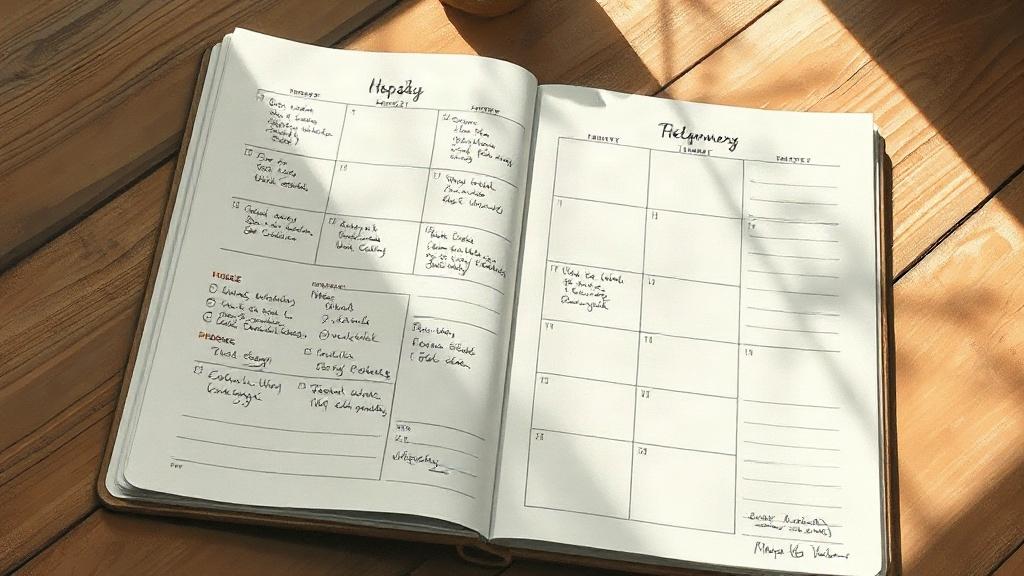
Today (10 minutes) Grab a sheet of paper. Write down the resolution that matters most to you right now. Just one. Then shrink it to its smallest possible version, one that takes less than 5 minutes.
Tomorrow Choose your anchor: the moment in your day where you'll attach this action. Write it down in black and white: "After [moment], I [action]."
Days 3 to 5 Do your small action. Nothing more. Don't try to do more, even if you feel like it. The goal is to build consistency, not to impress anyone. Just note each evening: "Done" or "Not done, and here's what I'm learning."
Day 6 Observe. What was easy? What resisted? Adjust without judging yourself. Maybe morning isn't the right time. Maybe the action needs to be even smaller.
Day 7 Celebrate. Sincerely. Even if you only managed 4 days out of 7, that's 4 more days than before. It's this recognition, not pressure, that builds lasting habits.
Also keep in mind that your energy depends on your body. Getting enough sleep, moving, breathing: these aren't details. If you're going through a demanding stretch, this article on staying productive on little sleep will help you keep going without falling apart.
And don't forget the golden rule: if all you can manage today is one tiny step, that's more than enough. A small yes beats a big no.
Conclusion: You've Already Begun
If you've made it this far, something in you hasn't given up. That part of you that still wants to move forward, to live better, to get closer to what matters, is intact. November didn't put anything out. It just slowed the pace.
Keeping your resolutions isn't a question of iron discipline. It's a question of intelligent gentleness: small actions, simple anchors, a kind view of yourself, and the trust that every day is a new chance to say yes.
The most beautiful transformations don't happen in a blaze of glory, but in the quiet repetition of small, aligned choices. And you can make those choices now.
So one last question: what's the one tiny action you can take today, in the next five minutes, to say yes to life?
If you'd like to keep exploring this more conscious, lighter, more aligned way of living, you're welcome at humans.team. You'll find more resources there to move forward at your own pace, with no pressure and no miracle promises.
Happiness is now ◯