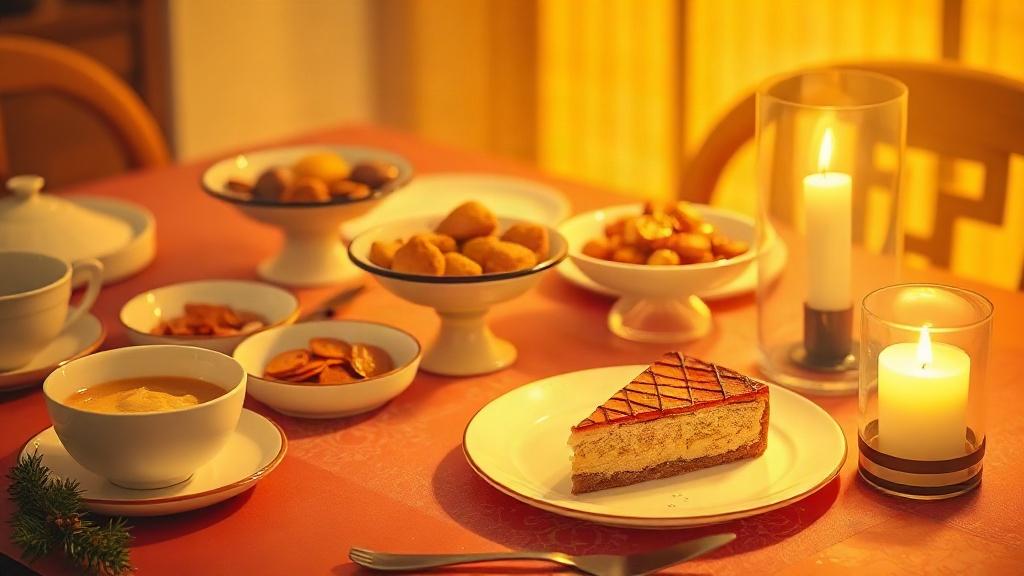
How to handle holiday meals without guilt: finding joy at the table again
You know the scene. The table is set, the smell of good food fills the house, laughter rises… and somewhere, a small voice settles in. "You shouldn't have seconds of dessert. You'll make up for it tomorrow. You've slipped up again."
Instead of savoring the moment, you count. You monitor. You bargain with yourself. And the next day, the guilt sometimes weighs heavier than the meal itself.
Here's the good news: you can learn to handle holiday meals without guilt. Not by controlling yourself more, but by radically changing the way you look at what's happening on your plate, and around your table.
This article isn't a diet in disguise. There are no lists of forbidden foods here, no compensating, no punishment. There's an invitation: to rediscover, starting with your very next meal, the simple joy of eating with the people you love.
"Even bare trees have a beauty that the leaves were hiding." — ◯ HUMANS.TEAM
This thought says something essential. When we strip away what weighs us down (the rules, the judgments, the "I should"), what remains is surprisingly beautiful: a meal, some faces, a moment. And you're already here to live it.
Understanding food guilt: where does it really come from?
Before figuring out how to handle holiday meals without guilt, you need to understand what this guilt actually is. Because it isn't here by chance, and it isn't as personal as it seems.
A learned emotion, not a truth
Nobody is born feeling guilty in front of a cake. A baby eats when hungry, stops when full, and savors with total presence. Food guilt, on the other hand, is learned. It builds up over the years, through the phrases we heard as children ("clean your plate," "you've had enough already"), the magazines promising to help you "get back on track after the holidays," the successive diets that turned food into a courtroom.
So what you feel at the table isn't proof that you're doing something wrong. It's conditioning, an old programming that fires automatically.
The egregore of restriction
At Humans.team, we often talk about egregores: those collective energies, those shared beliefs that influence us without our realizing it. There is a powerful egregore around food: the one that says pleasure has a price, that eating is a wrong to be atoned for, that the body is a problem to be managed.
You've been breathing in this belief for years, like the air around you. When you feel guilty over a holiday meal, it's not only your voice you're hearing. It's a collective echo. And the good news is that an egregore loses its power the moment you recognize it.
The trap of the restriction-guilt cycle
Here's a pattern many people live through without seeing it:
- You prepare for the meal by "cutting back" beforehand, to compensate
- You arrive starving, so you eat fast and without awareness
- You feel overwhelmed, then guilty
- You promise to "make up for it" over the following days
- And the cycle starts again at the next meal
This isn't a lack of willpower. It's a mechanism. And like any mechanism, it can be defused.
Why this matters in your life
You might think: "It's just a meal, it'll pass." But the way you experience the table says something bigger about your relationship with yourself.
What guilt steals from you
Every time you feel guilty at the table, you lose three precious things:
- The present: your attention is on self-criticism, not on the conversation or the flavors
- Connection: you're half-absent, locked in your head while the people you love are right there
- Energy: guilt is a heavy emotion that drains you far more than the meal itself
Holiday meals are among the rare moments when generations come together, when stories are told, when we share. Living them halfway means missing out on a gift.
A direct link to your energy and well-being
Food guilt doesn't stay at the table. It carries over into tension in the body, restless sleep, that dull fatigue that sets in when you're fighting yourself. If you feel that winter and the holidays are wearing you out, you'll find valuable ideas in how to deal with winter fatigue without waiting for spring. Because energy isn't regulated only through what's on your plate: it's also regulated through inner peace.
Happiness is now
This is where the Humans.team philosophy comes into its own. Many people postpone their well-being: "I'll relax once the holidays are over," "I'll enjoy myself once I've lost these pounds." But happiness isn't a future reward. It's a decision you can make right now, at this table, with this plate in front of you.
Happiness is now ◯
Practical keys to handling holiday meals without guilt
Let's get practical. Here are five simple keys you can apply starting with your next meal. You don't have to apply them all perfectly: pick the one that speaks to you and start there.
1. Stop restricting before the meal
It's counterintuitive, but it's key number one. Skipping a meal or eating very little in anticipation of the feast is the best way to create the overindulgence you dread.
Eat normally during the day. Arrive at the table with moderate hunger, not ravenous. Your body will thank you, and you'll be able to taste each dish calmly instead of diving in.
2. Return to sensation, not rules
Instead of asking yourself "am I allowed?", ask questions about how you feel: Am I still hungry? Does this dish bring me pleasure? How does my body feel right now?
This is the whole art of listening to your body without ignoring it, a subject we explore further in listening to your body without ignoring it. Your body holds a wisdom that diets have tried to silence. The holidays are a perfect opportunity to hear it again.
3. Truly savor (slowness is your ally)
A holiday meal is made to be tasted. Set your fork down between bites. Notice the textures, the aromas, the colors. Take the time to listen to whoever is speaking.
When you eat with presence, you naturally feel full sooner, and above all, you enjoy it more. Five savored bites are worth more than twenty swallowed while thinking about something else. You don't need to eat less: you need to eat present.
4. Replace judgment with curiosity
When the critical little voice appears, don't fight it, just notice it. Simply tell yourself: "Well, there's the guilt again." Without feeding it, without believing it.
This distance changes everything. You are not your guilt. You are the one observing it. And that simple step to the side takes away much of its power. If strong emotions often surface around these meals, turning intense emotions into creative strength can offer a complementary path.
5. Never make up for it afterward
This is the most liberating key. No "tomorrow I'll skip dinner," no punishing workout, no fasting to atone. The day after a holiday meal, you simply return to your normal rhythm, with kindness.
Compensating feeds the idea that pleasure is a debt. By dropping it, you break the cycle at its root. A meal doesn't define your week, your body, or your worth.
Putting it into practice right now: your three-step ritual
You don't have to wait for the big holiday dinner. Here's a small ritual you can try today, for any meal where guilt starts to creep in.
Before the meal: intention (1 minute)
Take three deep breaths. Then choose a simple intention, for example: "I'm here to savor and to be with the others." Not to control, not to perform. Just to be here.
During the meal: grounding (the whole way through)
Serve yourself what you're craving, in an amount that feels right. Eat slowly. If the critical little voice returns, gently name it and come back to your next bite. Reconnect with the faces around you: they're the real feast.
And if the atmosphere is tense, remember that a meal can also be a place of calm. We talk about this in how to handle tense family meals, to help you find peace even when conversations get delicate.
After the meal: gratitude (30 seconds)
Before moving on to something else, say thank you. Thank the food, the people who prepared it, your body that knew how to receive it. This gratitude seals the meal in softness rather than regret.
It's exactly what the thought of the day whispers to us: when we strip away the leaves of judgment, what remains is the bare beauty of the moment. A shared meal, quite simply.
An exercise for tonight
Take a sheet of paper and complete this sentence three times: "What I truly love about holiday meals is…" You'll see: your answers will talk about laughter, memories, warmth, rarely about calories. Keep this list in mind at your next meal. It will remind you why you're there.
Conclusion: you have the right to be happy at the table
Handling holiday meals without guilt isn't about becoming perfect, or never hearing that little voice again. It's about learning, meal after meal, to stop obeying it. To choose presence over control, gratitude over regret, connection over monitoring.
You don't need to earn your pleasure. You don't need to make up for it. You simply have the right to be there, whole, at this table, with the people you love. And you can give yourself that right starting now.
So here's a question to carry with you this week: what would happen if, at your next meal, you simply decided to savor it, without blaming yourself for anything?
Maybe you'll discover that the real celebration is that very freedom.
If this path speaks to you, you're invited to continue this reflection with us at humans.team, a space for those who choose to live consciously, freely, and happily, without waiting for "someday."
Happiness is now ◯