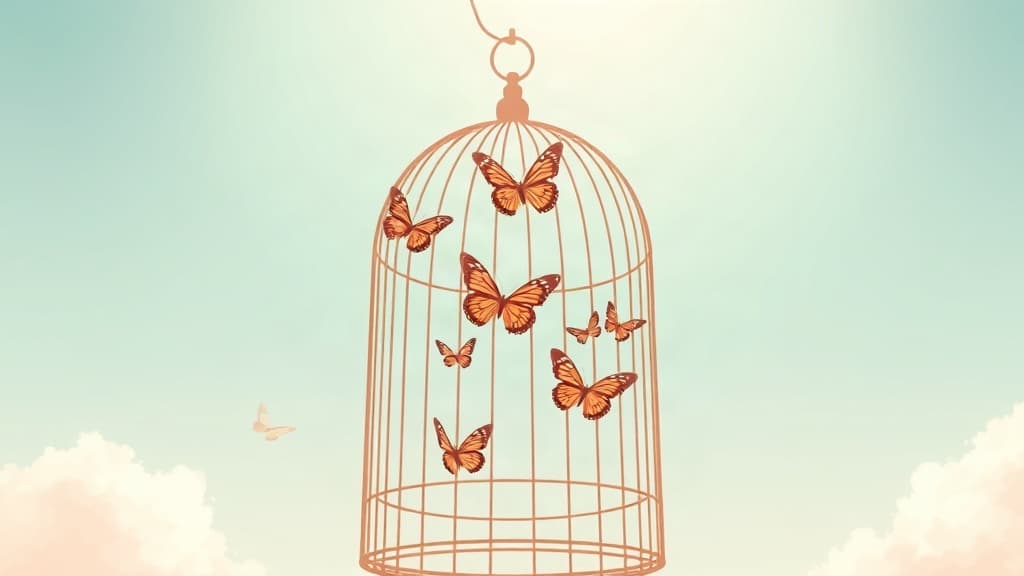
Staying at Peace While Waiting for Important News: 7 Techniques That Change Everything
You know that feeling. The knot in your stomach. That thought that circles back every ten minutes, like an alarm you can't switch off.
You're waiting. Medical test results. A response from an employer. A judge's verdict. A decision from someone close to you who holds part of your future in their hands.
And during that wait, something inside you tightens. You check your phone. You replay the scenarios. You imagine the worst, then the best, then the worst again. You're no longer really where you are — you're living in an imaginary future that doesn't exist yet.
That's not weakness. That's being human. But there are techniques for staying at peace while waiting for important news, and they can radically transform those hours of waiting into something far more bearable — even into a genuine experience of growth.
Understanding What's Actually Happening in Your Brain
Waiting activates a specific area of your brain: the amygdala, that small alarm center that can't distinguish between a real threat and an imagined one.
As far as it's concerned, waiting for a doctor's response and fleeing a predator are the same thing. It triggers the same hormonal cocktail: cortisol, adrenaline, muscle tension. Your body prepares to react to something that hasn't happened yet — and may never happen.
This is what's known as anticipatory anxiety. It's not there to make you suffer. It's there to protect you. Except that in 2025, most of our "threats" aren't predators — they're emails, phone calls, and results posted online.
The problem is that your nervous system doesn't know that.
Understanding this mechanism already gives you some power back. You're not "too sensitive." You're not "weak." You're human, wired with a brain designed for a world that no longer really exists.
And that awareness is the first step toward the techniques for staying at peace while waiting for important news.
Why Learning to Wait Changes Your Entire Life
You might think that waiting is a time in parentheses — a pause before real life resumes. That's a profound mistake.
Waiting is life. It's your present. And if you spend every period of uncertainty contracted in fear, you spend a significant portion of your existence suffering — over events that haven't happened yet.
Learning to stay grounded in calm during the wait means learning to live fully even when the future is uncertain. It's a skill that transfers everywhere: into your relationships, your work, the way you make decisions.
And there's something even deeper here.
When you learn not to be swept away by uncertainty, you develop a fundamental trust in yourself. You know that whatever the news turns out to be, you'll have the resources to handle it. That inner certainty is a form of freedom no one can take from you.
Happiness is now ◯ — even in the middle of waiting. Especially in the middle of waiting.
The 7 Concrete Keys to Staying at Peace While Waiting
1. The Sensory Grounding Technique (5-4-3-2-1)
When anxiety rises, your brain takes off into the future. Sensory grounding brings it back here, right now.
Pause. Look around you and mentally name:
- 5 things you can see
- 4 things you can touch
- 3 sounds you can hear
- 2 smells you can detect
- 1 thing you can taste or feel in your mouth
This exercise takes less than two minutes. And it sends a direct signal to your nervous system: there is no danger here, right now. It's one of the most effective and accessible techniques for staying at peace while waiting for important news.
2. Writing to Clear Your Mind
Your brain loops because it's trying to "solve" something it can't solve — the uncertainty of the future.
Writing interrupts that loop.
Grab a piece of paper or open a note on your phone. Write everything you're feeling, without filtering, without trying to be coherent. Let the fear, the anger, the hope, the sadness all come out. Everything.
Then ask yourself this simple question: What is actually true right now, at this precise moment?
Often the answer is: "I'm safe. I'm breathing. I don't know yet what's going to happen." And that's enough to find your footing again. If you tend to argue with your own head, writing can become your best tool for inner reconciliation.
3. The Two Circles Rule
Draw two circles — mentally or literally.
In the first: everything you have direct control over. Your breathing. Your actions in the present moment. What you eat, how you move, who you talk to.
In the second: everything that doesn't depend on you. The other person's decision. The outcome of the test. The jury's verdict.
Your energy can only act within the first circle. Everything you pour into the second is wasted energy — and a source of suffering.
This technique is simple, but it takes regular practice. Every time you feel anxiety rising, ask yourself: Am I in my circle of control, or the other one?
4. Movement as an Emotional Regulator
Anxiety is energy. And energy needs to move.
Walking, dancing, exercising, gardening, cooking — any physical movement helps your nervous system process the accumulated stress hormones. This isn't a metaphor; it's biology.
When you're waiting for important news, schedule movement into your day. Not to "take your mind off things" (though that helps too), but to help your body regulate itself physiologically.
Even 20 minutes of brisk walking can significantly lower your cortisol levels. And if you want to go deeper into managing your emotions, explore these 8 powerful techniques for achieving emotional freedom — some of them combine beautifully with physical grounding.
5. Coherent Breathing (or Heart-Focused Breathing)
This is one of the most powerful techniques for staying at peace while waiting for important news — and one of the most underrated.
It involves breathing at a specific rhythm: 5 seconds inhaling, 5 seconds exhaling. Continuously, for 5 to 10 minutes.
This rhythm synchronizes your heart, your brain, and your autonomic nervous system. It activates the vagus nerve — your body's primary calm regulator. Studies show that after just a few minutes of coherent breathing, cortisol drops, mental clarity increases, and anxiety recedes.
You can do it anywhere. In a waiting room. In your car. Before sleep. It's free, discreet, and it works.
6. Creating Your Personal "Waiting Protocol"
One of the reasons waiting is so hard is that it creates a void. And your brain fills voids with anxiety.
The solution: intentionally fill that void with chosen activities.
Not just any activities. The ones that ground you, nourish you, make you feel alive. It might be a creative project, a walk somewhere you love, a book that absorbs you completely, a deep conversation with someone who does you good.
Creating this protocol in advance — before anxiety sets in — gives you a roadmap. You don't have to decide what to do when you're in the middle of an inner storm. You simply follow your plan.
7. Welcoming Uncertainty as Information
This is perhaps the most counterintuitive technique — and the most transformative.
What if uncertainty weren't a problem to solve, but information to welcome?
It's telling you that you care about something. That this thing matters to you. That you're alive, engaged, present in your own life.
Uncertainty is the signature of everything worth having. Deep relationships, meaningful projects, courageous decisions — all of these come with uncertainty. Wanting to eliminate uncertainty means wanting to eliminate commitment.
When you welcome uncertainty with this perspective, something relaxes. You no longer have to fight it — you can simply let it be there, like a temporary traveling companion.
Immediate Practical Application: Your Waiting Day
Here's a concrete plan for a day when you're waiting for important news.
Morning (20 minutes) Start with 5 minutes of coherent breathing before looking at your phone. Then write for 10 minutes — everything that's in your head. Finish with 5 minutes of the 5-4-3-2-1 exercise to anchor yourself in the present.
Throughout the day Plan at least one 20-minute outing (walking, cycling, whatever works). Apply the two circles rule every time you feel your mind drifting toward worst-case scenarios. Engage in an activity from your waiting protocol.
Evening Before sleep, return to writing. Just one question: What did I handle well today? Even one small thing. Especially one small thing.
This rhythm structures your day and keeps you from floating in the void of waiting. If you want to strengthen your focus during these moments, the 7 techniques for staying focused all day long can complement this protocol perfectly.
These techniques for staying at peace while waiting for important news don't require hours of practice. They require consistency and a simple intention: choosing the present over the imaginary future.
What Waiting Can Teach You About Yourself
There's something nobody tells you about waiting.
It's a mirror.
It shows you where you place your sense of security. What you believe about yourself. The trust — or mistrust — you have in life. Your deepest patterns of thought.
A difficult period of waiting isn't an obstacle to get through as fast as possible. It's an invitation to know yourself better. To strengthen your relationship with yourself. To discover which techniques for staying at peace while waiting for important news truly resonate with who you are.
And whatever news arrives — good or bad — you'll come out stronger for having moved through it with awareness rather than resistance.
Happiness is now ◯ — not after the answer comes. Not once the uncertainty is lifted. Now, in this breath, in this present moment, which is the only place you've ever actually lived.
A question for you: Which technique in this article speaks to you most? Which one could you try today, in the next few hours?
Take a moment to actually answer that — genuinely. Not for me. For you.
If these ideas resonate with you, the Humans.team movement explores every day how to live more consciously, more freely, and more authentically — without jargon, without miracle promises. Just humans looking to live better, together. You can discover the community at humans.team whenever you feel ready. ◯