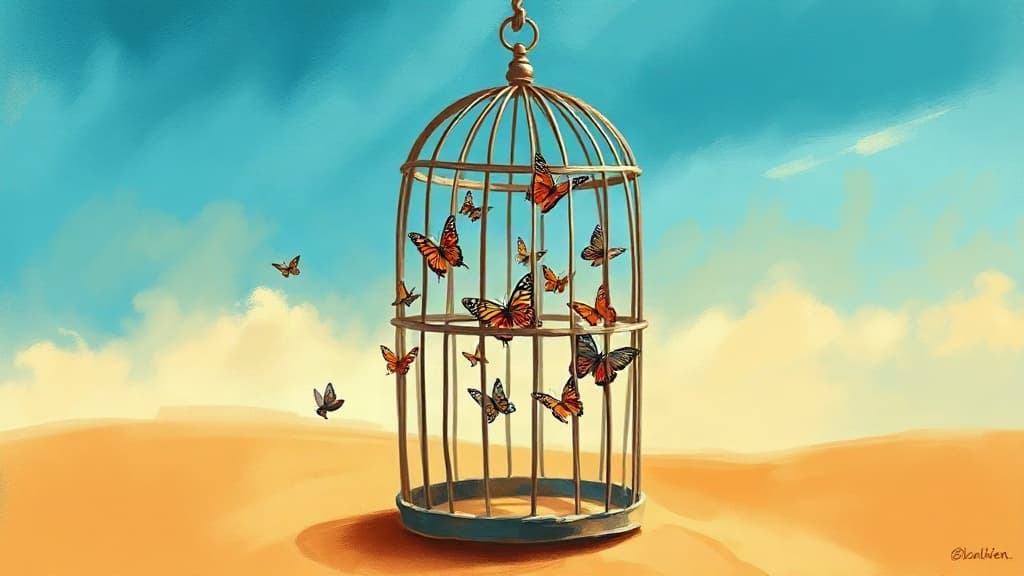
Stop Shrinking Yourself to Make Others Comfortable: The Guide to Taking Up Your Full Space
You know that moment? You're in a conversation, you have something important to say, an idea burning inside you… and you hold back. You water it down. You minimize it. You smile politely and let it pass.
Not because you're wrong. Not because your idea is bad.
But because a small inner voice whispers: "Don't take up too much space. Don't be a bother. Don't outshine anyone."
This pattern has a name. And understanding how to stop shrinking yourself to make others comfortable might be one of the most liberating decisions you ever make.
Understanding "Shrinking": When You Make Yourself Small So Others Feel Big
What does "shrinking" actually look like?
Shrinking — or self-diminishment — is the unconscious habit of making yourself smaller so you don't disturb other people's comfort.
It looks like this:
- You lower your voice when talking about your achievements
- You apologize for existing in a space
- You change your opinion the moment it meets any resistance
- You laugh at jokes that hurt you just to avoid tension
- You say "yes" when every part of you is screaming "no"
This isn't modesty. It's a form of quiet violence you're committing against yourself.
Where does this tendency come from?
This behavior takes root early. Sometimes in childhood, when being "too much" — too loud, too emotional, too ambitious — led to some form of rejection or punishment.
The child learns: "If I make myself small, I'm loved. If I take up space, I'm a problem."
This pattern survives into adulthood. It seeps into your relationships, your work, the way you show up in the world. And it costs you enormously.
Why Changing This Matters So Much
The real price of chosen invisibility
Every time you shrink, you send a message to your own brain: "I'm not worth being fully seen."
Repeated thousands of times, that message becomes a belief. And beliefs shape reality.
You start attracting relationships where you give far more than you receive. Environments where your silence gets mistaken for agreement. Situations where others make decisions for you, simply because you never clearly said what you wanted.
Learning how to stop shrinking yourself to make others comfortable isn't an act of selfishness. It's an act of truth.
What about the people around you?
Here's the paradox: by shrinking yourself, you're not actually doing anyone around you any favors.
You're offering them a filtered, muted, fearful version of you. Not the real one. And relationships built on that version are fragile, because they rest on an illusion.
Worse, your compressed energy creates a tension that others sense without being able to name it. The very discomfort you're trying to avoid — you end up creating it anyway.
Your authentic joy, on the other hand, is contagious. Your wholeness is inspiring. Your full presence — unfiltered and unapologetic — is a gift to the people around you.
If you want to go deeper on how to let go of a version of yourself that no longer fits, that's often the first step toward a more authentic and more liberated presence.
Practical Keys to Stop Making Yourself Small
1. Identify your shrinking triggers
You can't change what you can't yet see clearly.
Start by observing: in which situations do you shrink the most? Around whom? At what moments?
Maybe it's with your family. Maybe at work, in front of an authority figure. Maybe in social groups where you feel like the "odd one out."
Keep a journal for a week. Write down every moment you held back, minimized yourself, or disappeared. This simple act of observation already creates distance between you and the automatic behavior.
2. Recognize the difference between humility and erasure
Humility means knowing you're not better than others.
Erasure means believing you're less than them.
These two things have nothing to do with each other. You can be deeply humble and take up your full space. You can be gentle and clear. You can be generous and have boundaries.
Understanding how to stop shrinking yourself to make others comfortable starts with this essential distinction: you're not fighting your modesty. You're fighting your fear.
3. Practice being quiet without disappearing
There's an important nuance here.
Sometimes, not speaking is a wise choice. Listening deeply, observing, giving others room — these are genuinely valuable qualities.
But there's a difference between choosing silence and being reduced to silence by fear.
The next time you hold back from speaking, ask yourself: "Am I choosing to stay quiet, or is fear making that choice for me?"
That question alone can transform your relationship with your own voice.
4. Stop over-explaining and over-justifying
One of the most common forms of shrinking is the habit of constantly justifying yourself.
You say no, then spend ten minutes explaining why. You share an opinion, then bury it under "but maybe," "I'm not sure," "it's just my take."
It's exhausting. And it weakens your message.
You are allowed to have opinions, needs, and boundaries — without having to defend them like you're on trial. If this resonates, explore how to stop over-explaining yourself in your relationships and reclaim a natural dignity in your interactions.
5. Retrain your nervous system to tolerate visibility
Shrinking is as much a physiological response as a psychological one. Your body is literally conditioned to contract in certain social situations.
The good news: that conditioning can be undone.
Start small. Speak up in a meeting, even briefly. Express a preference you would normally keep to yourself. Share a win without immediately apologizing for it.
Each small act of visibility recalibrates your nervous system. It learns that taking up space is safe. And gradually, contraction becomes expansion.
Immediate Practical Application: What You Can Do Today
No need to wait until you feel "ready." The transformation starts now, in the next few hours.
Exercise 1 — The unapologetic sentence: Today, say one true thing without apologizing for it. Just one. No "sorry to bother you," no "this is probably a stupid idea, but…" One clean, clear sentence with no safety net.
Exercise 2 — The body that takes up space: Notice your posture right now. Are your shoulders hunched inward? Is your gaze lowered? Your body speaks before you even open your mouth. Sit up. Occupy the physical space you deserve.
Exercise 3 — Your wins inventory: Take five minutes to write down three things you accomplished this week — even small ones — without minimizing them. Write them as if you were telling someone you deeply admire. Not with arrogance. With honesty.
These practices might seem simple. They are powerful. Because how to stop shrinking yourself to make others comfortable doesn't begin with a grand revolution. It begins with a single authentic gesture, repeated.
If you want to go further in the professional space, you'll find very concrete ideas in this article on stopping people-pleasing at work and reclaiming your power. Because the workplace is often where this shrinking runs deepest — and costs the most.
And if you're wondering how to live more aligned with who you truly are without betraying yourself — including in how you create or work — this article on making money doing what you love without selling yourself out opens up a liberating perspective.
Conclusion: Your Place Doesn't Need to Be Earned — It Already Belongs to You
Knowing how to stop shrinking yourself to make others comfortable isn't about becoming someone else.
It's about coming back to yourself.
It's about remembering that your presence — whole, authentic, luminous — isn't a burden on others. It's a contribution.
Remember today's thought: Your joy is contagious. Share it freely. But to share your joy, you first have to stop smothering it under layers of apology and false modesty.
How to stop shrinking yourself to make others comfortable isn't a question of technique. It's a question of decision. The decision to choose yourself — right now, in this moment — without waiting for anyone else's permission.
Not perfectly. Not all at once.
But today. One gesture. One sentence. One deeper breath.
And you — in which area of your life do you shrink most often, and what's stopping you from taking up your full space?
✨ If this article spoke to you, Humans.team is a space built for humans who choose to wake up — not "someday," but now. Come explore, at your own pace, without pressure.
Happiness is now ◯