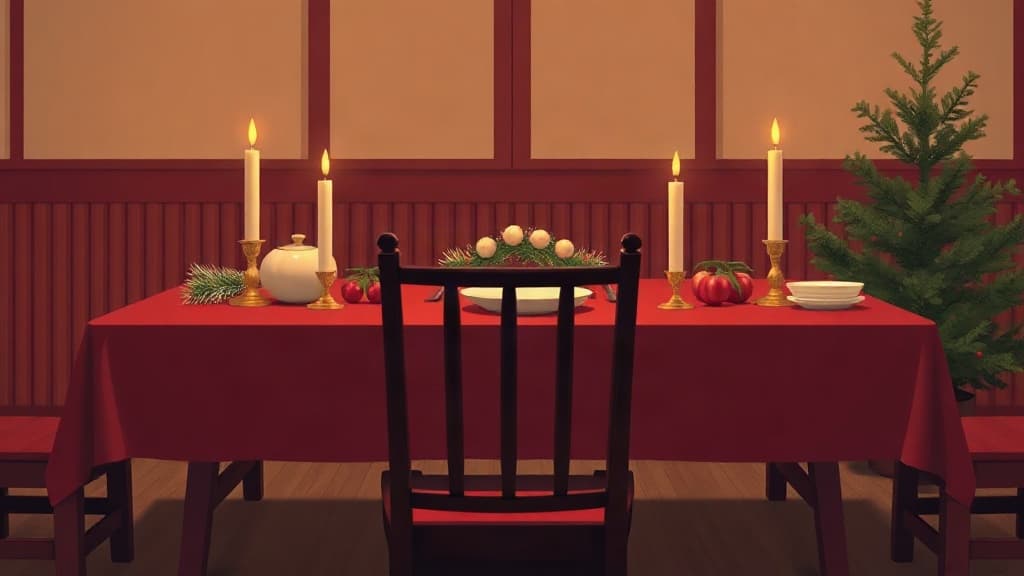
How to Handle Grief During the Holidays: How to Stay Standing When Everyone Else Is Celebrating
There's something particularly cruel about the collision of grief and the holiday season. The world strings up its lights, families gather together, cheerful songs flood every store — and you're carrying an absence that weighs heavier than ever.
If you're reading this, maybe it's because you're approaching the holidays with that knot in your throat. That feeling that you should be happy, but that something — someone — is missing. And the collective pressure to be joyful makes your own pain feel even more isolating.
You're not alone. And you don't have to pretend.
This article has no miracle cure to offer. But it has something more valuable: honest, grounded guidance on how to handle grief during holidays without betraying yourself, without cutting yourself off from others, and without losing sight of who you are.
Understanding Grief During the Holidays: What's Really Happening
Grief doesn't move in a straight line. It's shifting terrain, with its quiet patches and its sudden storms.
And the holidays act like an amplifier.
Why? Because the holidays are rituals. Annual repetitions loaded with sensory memory: the smell of a Christmas roast, the song that always played at dinner, the empty seat at the end of the table. These sensory triggers reactivate pain with surgical precision, sometimes years after a loss.
Grief during the holidays is also the collision of two realities:
- The outside world saying "be joyful"
- Your inner world saying "something is broken"
This dissonance creates what psychologists call holiday complicated grief — a form of emotional isolation that surfaces precisely when the people around you expect to see you smiling.
Understanding this mechanism is already an act of self-compassion. What you're feeling isn't weakness. It's a deeply human, entirely normal response to a real loss.
Why Learning How to Handle Grief During Holidays Changes Everything
We tend to underestimate the impact this time of year has on our overall wellbeing.
The holiday season compresses a massive amount of emotional, social, and physical demands into just a few weeks. For someone who is grieving, this can lead to profound exhaustion — not just emotional, but physical.
Sleep becomes fragmented. Appetite turns erratic. The body stores tension wherever it can — in the shoulders, the jaw, the gut. If you're noticing these physical signals, know that they're intimately connected to what you're going through emotionally. Releasing that tension in the body is an integral part of moving through grief.
But there's another, deeper reason why knowing how to handle grief during holidays is a question worth taking seriously.
The holidays, for all their heaviness, also carry an invitation.
November offers its mist as an invitation to look inward. — ◯ HUMANS.TEAM
Grief, when faced with awareness rather than drowned out in the noise of celebration, can become a path toward something more real. Toward a more authentic relationship with yourself, with others, with what remains after loss.
Not learning to move through this season means risking living it on repeat, year after year, never finding room to breathe.
Practical Keys for How to Handle Grief During Holidays
Here's what actually works — not magic formulas, but solid anchors.
1. Allow Grief Without a Timeline
The first mistake many grieving people make is wanting to be "over it" before the holidays arrive.
As if the pain needs to disappear so it doesn't disrupt the collective celebration.
Give yourself permission to not be ready. Give yourself permission to feel sad at midnight on New Year's Eve if that's what's true for you. Grief doesn't run on a schedule. Forcing it into a time frame doesn't resolve it — it just defers it, with interest.
Simply tell yourself: "I can feel sadness AND still be present. The two aren't mutually exclusive."
2. Create Rituals of Honoring Rather Than Avoiding
One of the most powerful ways to handle grief during holidays is not to ignore the absence, but to give it a conscious place.
Light a candle for the person you've lost. Cook their favorite meal. Share a memory around the table. Leave an empty glass beside yours, as some traditions do.
These rituals don't prolong the pain. They integrate it. They transform absence into symbolic presence — and that changes everything.
3. Set Boundaries Without Guilt
The holidays often come with intense social pressure: obligatory family gatherings, meals that stretch on for hours, intrusive questions about how you're "holding up."
If you're grieving, you have every right to say no. To leave early. To skip certain events. To carve out regular pockets of restorative solitude in the middle of the collective chaos.
Learning to set boundaries with family during the holidays isn't selfishness. It's intelligent emotional survival. And paradoxically, it allows you to be more genuinely present in the moments you actually choose to show up for.
4. Make Your Body a Priority
When the mind is suffering, the body needs more attention, not less.
Keep your sleep schedule as consistent as possible. Eat food that actually nourishes you. Move — even a 20-minute walk in the December cold can shift stagnant energy.
The holidays can also trigger intense sensory overload: noise, lights, crowds, other people's emotions. Having concrete strategies to manage this protects you from cumulative exhaustion.
5. Find at Least One Person You Can Really Talk To
Grief thrives in isolation and slowly dissolves in genuine connection.
You don't need everyone to understand. You need one person — just one — to whom you can say "I'm really not okay" without having to follow it up with a smile.
A close friend. A therapist. An online support group. That connection is a safety net that makes all the difference when you're falling.
Immediate Practical Application: What You Can Do Today
Knowing how to handle grief during holidays doesn't start on December 24th. It starts now, in the weeks leading up to it.
Tonight, try this simple exercise:
Take a sheet of paper (not your phone — paper, with a pen). Divide it into three columns.
- Column 1: What I'm dreading about the upcoming holidays
- Column 2: What I need to get through it
- Column 3: One concrete action I can take this week
This isn't a forced-positivity exercise. It's an act of clear-eyed self-compassion.
By naming what you're dreading, you take away some of its power. By identifying your needs, you begin to be able to honor them. By choosing one action, you reclaim a sense of agency over your own experience.
A few concrete ideas for this week:
- Let one or two people close to you know where you're at emotionally, before the holidays hit
- Schedule time for yourself in your calendar — actual blocks of time that belong only to you
- Create or adapt a ritual that honors the person you're grieving
- Identify which events you'll genuinely attend, and which ones you can decline
- Prepare your home as a refuge: turning your space into a sanctuary can be a deeply therapeutic act during grief
The goal isn't to get through the holidays without pain. The goal is to get through them without losing yourself.
And to stay emotionally grounded through this turbulent season, take a look at this honest guide to emotional anchoring during the holidays — it's the perfect companion to what you've just read.
What You Take Away From All This
How to handle grief during holidays isn't about emotional performance. It's not "how to pretend you're fine." It's "how to stay whole during a season that strips everything bare."
Grief during the holidays is one of the loneliest human experiences there is. And yet, millions of people are living it simultaneously, in silence, behind their Christmas decorations.
You're not broken. You love. And loving means losing, sometimes.
The November mist isn't there to blind you. It's there to remind you that looking inward is also an act of courage.
What you feel is real. What you carry deserves to be honored. And you deserve concrete tools to move through this season without sacrificing yourself on the altar of collective joy.
A question for you: What's the one small gesture — just one — you could make this week to honor both your pain and your capacity to keep going?
Take the time to really answer that.
At Humans.team, we believe happiness isn't a destination you reach "when things get better." It's an orientation you choose, right now, even in the hard moments. If these reflections resonate with you, you're welcome in our community — a space for people who choose to live more consciously, with all their complexity. Discover Humans.team →
Happiness is now ◯