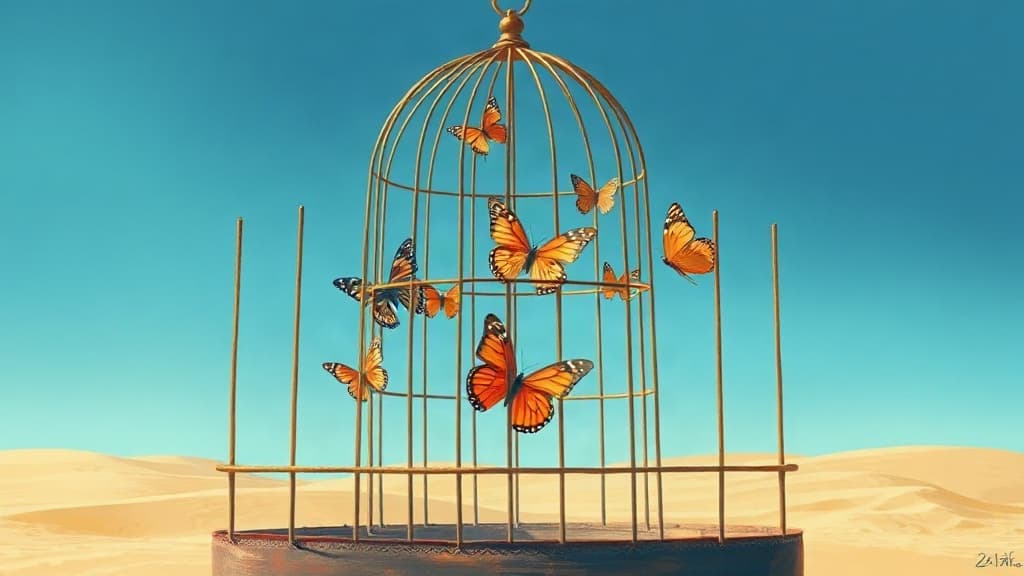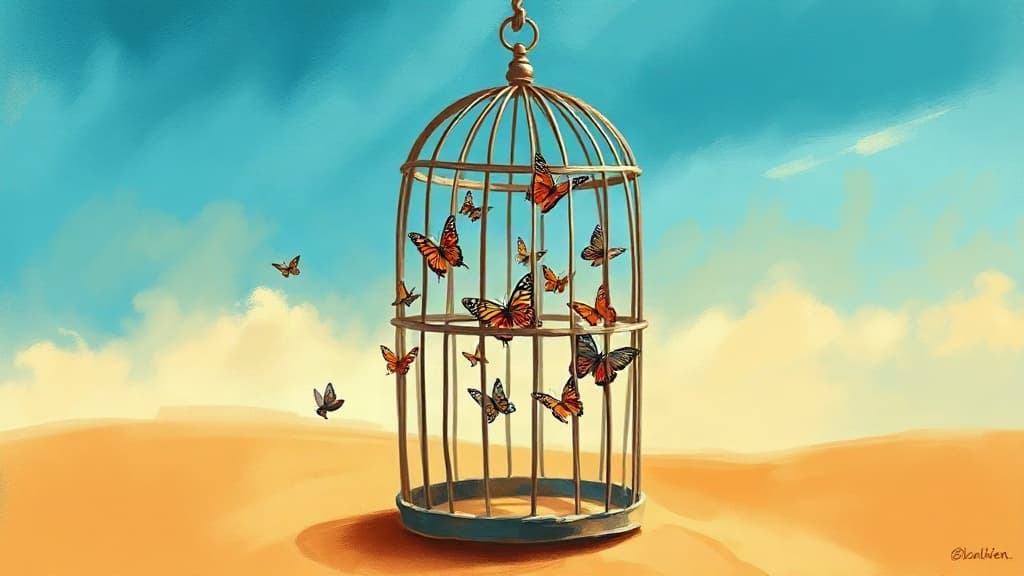
When Your Life No Longer Belongs to You: How to Stop Feeling Like Your Life Belongs to Everyone Else
It's 10:47 PM.
You're sitting in the kitchen, finally alone after a day that wasn't yours for a single second. The morning: requests from colleagues. The afternoon: expectations from family. The evening: messages piling up, each one claiming a piece of you.
And there, in that rare silence, a thought drifts through — soft, almost hesitant:
Did I do a single thing today because I actually wanted to?
The answer takes too long to come.
Maybe that's the quietest sign of all: no longer knowing where others end and where you begin. No longer feeling the boundary between what you choose and what's expected of you. Living a life that looks like yours, but revolves around everyone else's needs, fears, and plans — everyone's but your own.
Learning how to stop feeling like your life belongs to everyone else doesn't happen through some grand declaration of independence. It starts with that question in the kitchen, at 10:47 PM, when everyone else is asleep.
What Really Changes When You Finally Understand
There's a belief many of us carry without realizing it: if I'm available for everyone, I'll be loved. Safe. Worthy.
That belief didn't come from nowhere. It was built by watching the world around us — adults who made themselves invisible to be accepted, messages that rewarded self-sacrifice, collective narratives that glorify self-erasure as a virtue.
So we learn to make ourselves useful. To say yes before we've even thought it through. To organize our lives around other people's schedules, other people's moods, other people's fears.
And one day, we realize we no longer know what we enjoy. What we're missing. What we actually want. Because we never got into the habit of asking.
What changes when you truly understand isn't that you become selfish. It's that you realize losing yourself doesn't save anyone. A life emptied of its own presence can't be fully given to others. Genuine generosity comes from someone who actually exists — not from someone who erased themselves out of fear.
Inner peace begins when you stop fighting against yourself. And that fight, more often than not, is precisely the struggle to remain yourself in a world that constantly asks you to exist for others.
Lesson 1: Total Availability Isn't a Virtue — It's a Signal
We often confuse "being a good person" with "being available to everyone, all the time."
But total availability isn't an admirable character trait. It's a signal. A sign that a boundary doesn't yet exist. That a "no" has never been spoken. That a need for external validation is making decisions instead of your own inner sense of self.
How to stop feeling like your life belongs to everyone else starts here: by recognizing that every "yes" given out of fear or obligation is a "no" said to yourself.
That's not a judgment. It's an observation.
The question isn't "am I generous enough?" but "am I saying yes because I genuinely want to, or because I'm afraid of what happens if I say no?"
The honest answer to that question is often uncomfortable. And that's exactly where freedom begins.
Lesson 2: Identity Isn't Built in Other People's Eyes
There's an experience many people recognize: walking into a room and instinctively scanning who needs what. Who's angry, who's disappointed, who's waiting for something. And adjusting your behavior accordingly.
This reflex is sometimes called empathy. Sometimes sensitivity. But when it becomes automatic — when you can't help it — it's often a sign that you learned very early on that your safety depended on keeping others satisfied.
The problem: an identity built in other people's eyes isn't an identity. It's a mirror.
And a mirror can't have a life of its own.
Learning how to stop feeling like your life belongs to everyone else means starting to ask: outside of everyone else's expectations, who am I? What do I enjoy? What lights me up, even when no one is watching?
These questions sound simple. They're not. But they're the beginning of something real.
If you often feel out of step with what you're "supposed" to feel according to others, you might recognize that sense of never being enough — the feeling that no matter what you do, it's never quite enough for someone.
Lesson 3: Rest Is Not a Reward
One of the most subtle ways we steal our own lives: believing we have to earn the right to exist for ourselves.
We rest when all the tasks are done. We take time for ourselves when everyone is satisfied. We allow ourselves to be happy when we've "given enough."
But that moment never really arrives. Because there's always something left to do. Always someone else to satisfy. Always a reason to put off existing for yourself until later.
This logic — rest as a reward — is one of the most effective ways to never actually live your own life. It turns existence into a long checklist of conditions to meet before you're allowed to simply be.
You don't need to earn rest. That's not a way of dodging responsibility. It's a fundamental truth: your worth isn't conditional on your productivity.
To exist — truly, fully — is a right. Not a reward.
Lesson 4: Freedom Isn't the Absence of Others — It's the Presence of Yourself
We often imagine that reclaiming our lives looks like a dramatic break. Leaving everything behind. Changing everything. Starting over somewhere else, some other way.
But how to stop feeling like your life belongs to everyone else isn't about geography or radical change.
It's about attention.
Where is your attention right now? On what you're feeling? Or on what others might think, expect, or judge?
Inner freedom begins in that tiny space between stimulus and response. In that fraction of a second where you can ask yourself: is this decision coming from me, or am I trying to manage someone else's emotions?
It's not dramatic. But that's where everything happens.
And if you sometimes feel like your life is a system you can't escape, you're not alone — it's a feeling many people describe as living in a trap, even when everything looks fine from the outside.
The Shift: How to Start Reclaiming Your Life Today
Not tomorrow. Not when conditions are perfect. Now.
Here's what can actually change — no grand speeches, no dramatic overhauls required.
1. Pause before saying yes. Not to refuse everything. Just to check in. Do I actually want this, or am I trying to avoid something? Three seconds of internal verification. That's all it takes.
2. Find one thing each day that comes from you. One decision, even a small one. What you're having for dinner. The route you take home. The conversation you choose to have — or not have. Actively look for the moment when it's your voice speaking, not social autopilot.
3. Name the moments of self-loss without judgment. When you realize you just spent two hours managing someone else's emotions without a single thought for yourself — notice it. Without guilt. Just see it. Awareness always comes before change.
4. Create a space that belongs only to you. Not necessarily a physical one. A moment. A ritual. Ten minutes in the morning before the notifications start. A journal. A walk without a podcast or your phone. A space where you have nothing to do for anyone.
5. Stop chasing your own life. Life can't be caught up with. It's lived, right now, in what's already here. The question isn't "how do I do more?" but "how do I show up more fully to what's already here?"
How to stop feeling like your life belongs to everyone else isn't a destination. It's a daily practice. A return to yourself, again and again, without punishing yourself for every time you got lost along the way.
Back to 10:47 PM
Imagine living that scene again.
The quiet kitchen. The day just ended. The same question drifting through: did I do a single thing today because I wanted to?
But this time, the answer comes faster. Yes — there was that moment this morning, before everything started, when you simply held your coffee and looked out the window. No phone. No to-do list. Just there.
It wasn't much.
And yet, it was you. Really you.
That's what the shift looks like. Not a life perfectly free of all constraints — no one has that. But a life where, even in the middle of the noise, there are still a few moments that belong only to you. A few decisions that come from within. A presence to yourself that doesn't completely disappear, even when everything is pulling in the other direction.
How to stop feeling like your life belongs to everyone else — it's learning to come back to yourself. Not once, not in some grand moment of revelation. But a thousand times, gently, in the small spaces of ordinary life.
Happiness is now ◯
If these questions resonate with you, explore the other reflections on the Humans.team blog — each article is an invitation to see your life differently, at your own pace, without pressure.